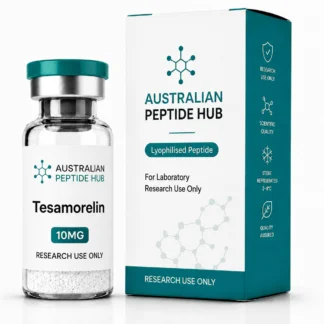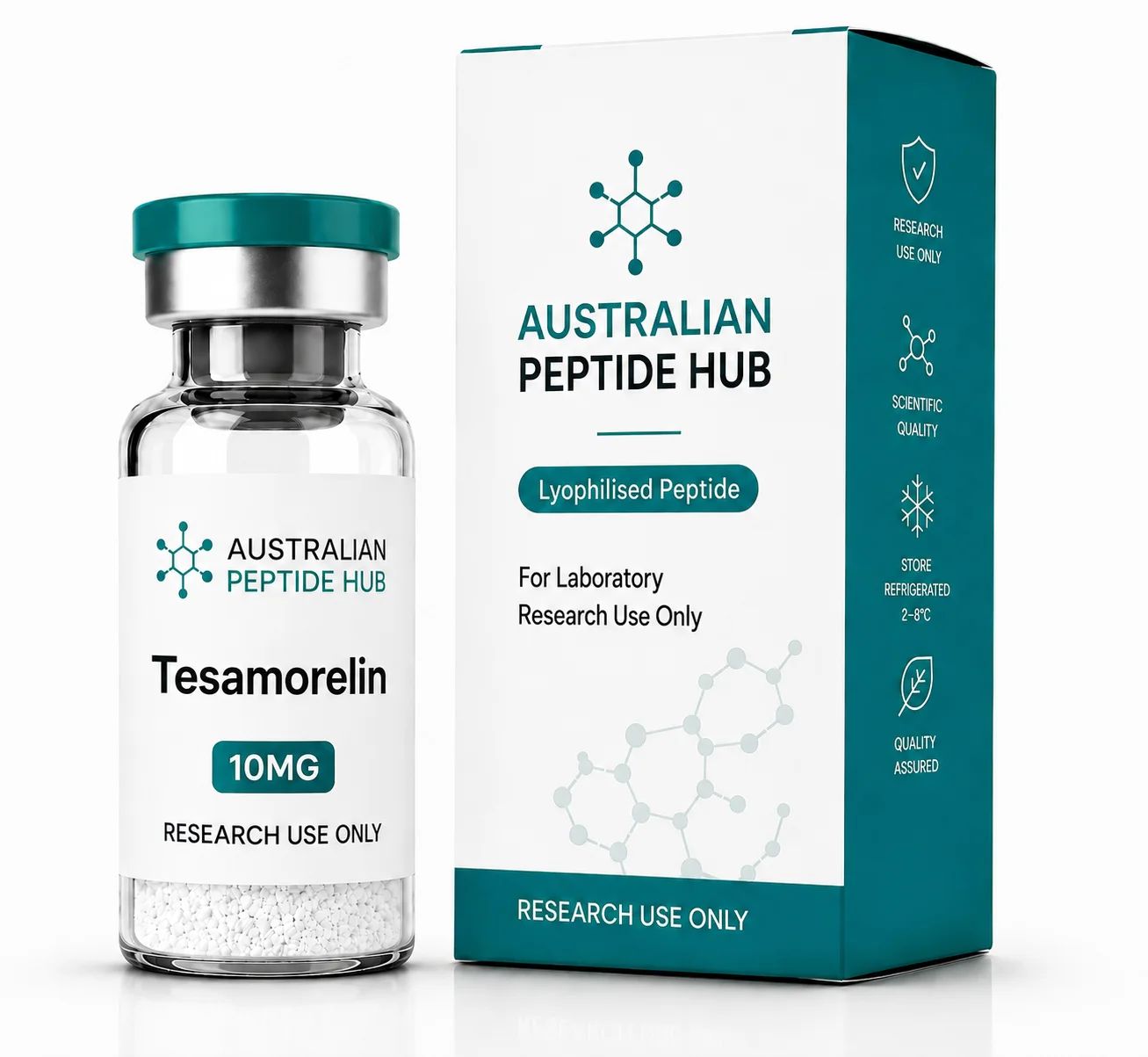
Tesamorelin
$89.00
Processing time is 1–2 business days.
Tesamorelin lyophilised research peptide in Australia, supplied for in-vitro laboratory investigation. Synthetic 44-amino-acid analogue of growth hormone-releasing hormone (GHRH) with N-terminal trans-3-hexenoyl modification for DPP-4 resistance. ≥99% purity by HPLC, third-party Certificate of Analysis available. Dispatched within 1-3 business days. Research use only. Not for human consumption, therapeutic use, or diagnostic application.
Research Context
Tesamorelin is a synthetic 44-amino-acid analogue of human growth hormone-releasing hormone (GHRH), structurally identical to native GHRH(1-44) but stabilised by attachment of a trans-3-hexenoic acid (hexenoyl) group to the N-terminal tyrosine residue. This lipophilic modification confers resistance to dipeptidyl peptidase IV (DPP-4) cleavage, the principal degradation pathway for native GHRH, and substantially extends plasma half-life relative to the unmodified peptide. Tesamorelin belongs to the GHRH analogue class alongside sermorelin and CJC-1295, and acts as a selective full agonist at the pituitary GHRH receptor.
Preclinical and clinical literature has examined the effects of GHRH receptor agonism on endogenous growth hormone pulsatility, IGF-1 dynamics, lipolysis in visceral adipose depots, and hepatic lipid metabolism. The compound has been used as a pharmacological probe of GH-axis regulation in research models investigating lipodystrophy, ectopic fat deposition, and somatotropic signalling.
Chemistry & Structural Modification
Linear 44-residue peptide with the GHRH(1-44) sequence YADAIFTNSYRKVLGQLSARKLLQDIMSRQQGESNQERGARARL and a trans-3-hexenoyl group covalently attached to the alpha-amino group of the N-terminal tyrosine, conferring DPP-4 resistance.
- Molecular formula: C221H366N72O67S
- Molecular weight: 5135.86 g/mol (free peptide)
- CAS number: 218949-48-5 (free peptide); 901758-09-6 (acetate salt). PubChem CID 16137828
Lyophilisation & Stability
Supplied as a lyophilised white-to-off-white powder under inert atmosphere in a sealed glass vial. Lyophilisation removes residual water that would otherwise drive amide-bond hydrolysis and oxidation of the internal methionine residue. The dry-state form is stable for extended periods provided the vial is kept sealed, cold, and protected from light. Open vials and reconstituted material are markedly less stable and should be handled accordingly.
Storage
Store lyophilised vial at 2 to 8°C, protected from light. (Long-term storage at −20°C is standard practice.)
Reconstituted solution: 2 to 8°C, used within 14 to 30 days. Avoid repeated freeze-thaw cycles.
Quality & Documentation
- Purity: ≥99% by HPLC
- Certificate of Analysis (COA): published on our COA page.
Related products
-
Selank
$50.00 Select options This product has multiple variants. The options may be chosen on the product page -
Kisspeptin-10
$75.00 Select options This product has multiple variants. The options may be chosen on the product page -
GLP-3R
Price range: $95.00 through $340.00 Select options This product has multiple variants. The options may be chosen on the product page