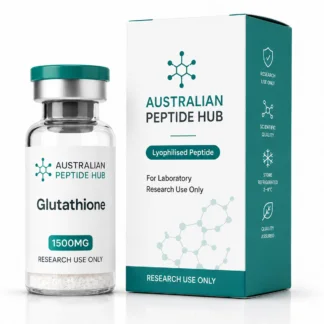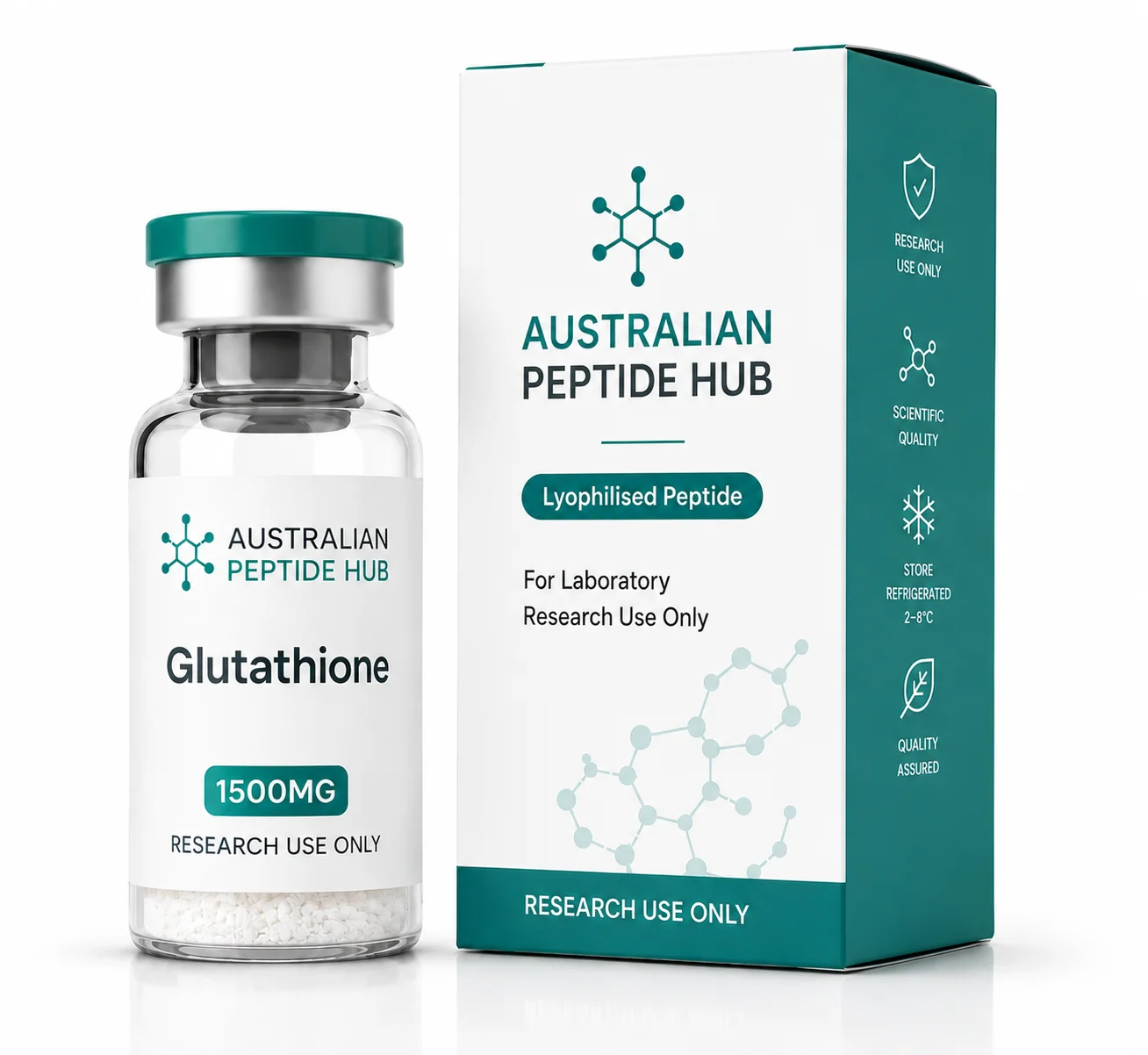
Glutathione
$64.00
Processing time is 1–2 business days.
Glutathione lyophilised research peptide in Australia, supplied for in-vitro laboratory investigation. Endogenous tripeptide antioxidant (γ-Glu-Cys-Gly) with a non-standard γ-peptide bond between glutamate and cysteine. ≥99% purity by HPLC, third-party Certificate of Analysis available. Dispatched within 1-3 business days. Research use only. Not for human consumption, therapeutic use, or diagnostic application.
Research Context
Glutathione (reduced, GSH) is an endogenous tripeptide composed of L-glutamate, L-cysteine, and glycine. Its defining structural feature is an unusual gamma-peptide bond between the side-chain carboxyl of glutamate and the alpha-amino group of cysteine, distinguishing it from canonical alpha-peptide-linked tripeptides and rendering it resistant to most standard peptidases. The free thiol on the cysteine residue is the chemically active group and is the substrate site for redox cycling, conjugation reactions, and disulphide formation. Glutathione is present in millimolar intracellular concentrations across virtually all aerobic organisms and is considered the principal small-molecule thiol antioxidant of the cell.
Preclinical studies have examined glutathione as a research tool for investigating oxidative stress, mitochondrial function, xenobiotic conjugation by glutathione S-transferase, hepatic detoxification pathways, and redox-sensitive transcription factor regulation. The reduced form (GSH) is also widely used in protein chemistry for elution of GST-tagged recombinant proteins from glutathione-affinity resins.
Chemistry & Structural Modification
Glutathione is the tripeptide γ-L-glutamyl-L-cysteinylglycine. The reduced free-acid form is supplied here; the oxidised disulphide-linked dimer (GSSG, MW 612.6) is a distinct species. The active thiol is highly air-sensitive and oxidises to GSSG on prolonged exposure to atmospheric oxygen.
- Sequence: γ-Glu-Cys-Gly (3 residues; one non-standard γ-peptide bond)
- Molecular formula: C10H17N3O6S
- Molecular weight: 307.32 g/mol
- CAS number: 70-18-8; PubChem CID 124886
Lyophilisation & Stability
Glutathione is supplied as a lyophilised white powder, sealed under controlled conditions to limit exposure to atmospheric oxygen and moisture. Lyophilisation removes residual water that would otherwise promote thiol oxidation and hydrolytic degradation. The free thiol is the principal stability liability: oxidation to the GSSG disulphide is thermodynamically favoured in aqueous solution and accelerated by elevated pH, transition-metal contamination, and warm temperatures. Sealed vials kept cold and dry retain ≥99% potency well within the labelled shelf life.
Storage
Store lyophilised vial at 2 to 8°C, protected from light. (Long-term storage at −20°C is standard practice.)
Reconstituted solution: 2 to 8°C, used within 14 to 30 days. Reconstituted GSH oxidises measurably over days in aqueous buffer; for redox-sensitive assays prepare fresh from lyophilised stock. Avoid repeated freeze–thaw cycles.
Quality & Documentation
- Purity: ≥99% by HPLC
- Certificate of Analysis (COA): published on our COA page.
Related products
-
KPV
$45.00 Select options This product has multiple variants. The options may be chosen on the product page -
Cagrilintide
$85.00 Select options This product has multiple variants. The options may be chosen on the product page -
Tesamorelin
$89.00 Select options This product has multiple variants. The options may be chosen on the product page