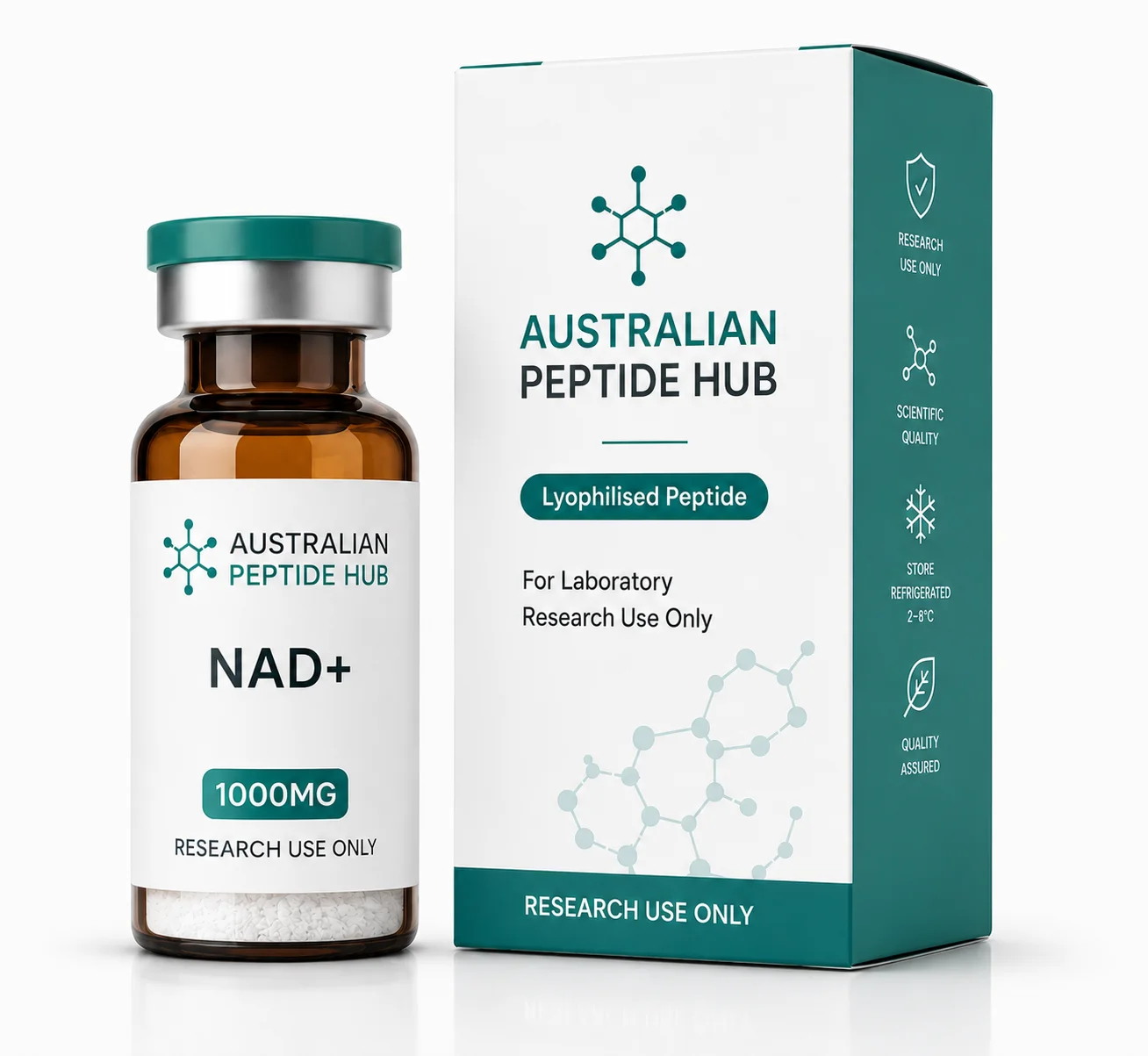
NAD+
$89.00
Processing time is 1–2 business days.
NAD+ lyophilised research nucleotide cofactor in Australia, supplied for in-vitro laboratory investigation. β-Nicotinamide adenine dinucleotide (oxidised, free-acid form), the principal electron-acceptor cofactor in cellular energy metabolism. ≥99% purity by HPLC, third-party Certificate of Analysis available. Dispatched within 1-3 business days. Research use only. Not for human consumption, therapeutic use, or diagnostic application.
Research Context
NAD+ (β-nicotinamide adenine dinucleotide, oxidised free-acid form) is a nucleotide cofactor consisting of two ribose-linked nucleotides joined through their phosphate groups: one carrying an adenine base, the other a nicotinamide base. It is not a peptide. NAD+ is present in every living cell and operates as the principal electron-acceptor in central energy metabolism, accepting a hydride during catabolic oxidations and shuttling reducing equivalents through reduction to NADH. Beyond redox cycling, NAD+ functions as a substrate consumed (not merely catalysed) by sirtuin deacylases, PARP DNA-repair enzymes, and CD38 ectoenzymes, linking cellular NAD+ availability to chromatin signalling and DNA-damage response pathways.
Preclinical studies have examined NAD+ as a research tool for investigating mitochondrial bioenergetics, sirtuin-mediated metabolic regulation, ageing-associated NAD+ decline, and the cofactor’s role in skeletal-muscle and hepatic energy homeostasis. The compound is widely used in in-vitro enzyme assays as the obligate cosubstrate for hundreds of NAD+-dependent oxidoreductases.
Chemistry & Structural Modification
NAD+ is a dinucleotide built from adenosine monophosphate (AMP) and nicotinamide mononucleotide (NMN) joined through a pyrophosphate bridge. The supplied material is the oxidised free-acid form (not the reduced NADH species, which has a distinct molecular weight and absorbance profile).
- Molecular formula: C21H27N7O14P2
- Molecular weight: 663.43 g/mol
- CAS number: 53-84-9; PubChem CID 5893
Lyophilisation & Stability
NAD+ is supplied as a lyophilised powder in an amber glass vial, sealed under controlled conditions. The amber glass is a deliberate packaging choice: NAD+ is a light-sensitive nucleotide cofactor, and prolonged UV/visible exposure can drive degradation of the nicotinamide ring and pyrophosphate bond. Lyophilisation removes residual moisture that would otherwise accelerate hydrolytic degradation of the pyrophosphate linkage during storage. Vials should remain sealed and shielded from light until immediately before reconstitution.
Storage
Store lyophilised vial at 2 to 8°C, protected from light, in the original sealed amber glass vial. (Long-term storage at −20°C is standard practice.)
Reconstituted solution: 2 to 8°C, used within 14 to 30 days. Aqueous NAD+ solutions are pH-sensitive (most stable around pH 2 to 4) and degrade more rapidly under alkaline conditions. Avoid repeated freeze–thaw cycles.
Quality & Documentation
- Purity: ≥99% by HPLC
- Certificate of Analysis (COA): published on our COA page.
Related products
-
KLOW
$125.00 Select options This product has multiple variants. The options may be chosen on the product page -
SS-31
$69.00 Select options This product has multiple variants. The options may be chosen on the product page -
Kisspeptin-10
$75.00 Select options This product has multiple variants. The options may be chosen on the product page