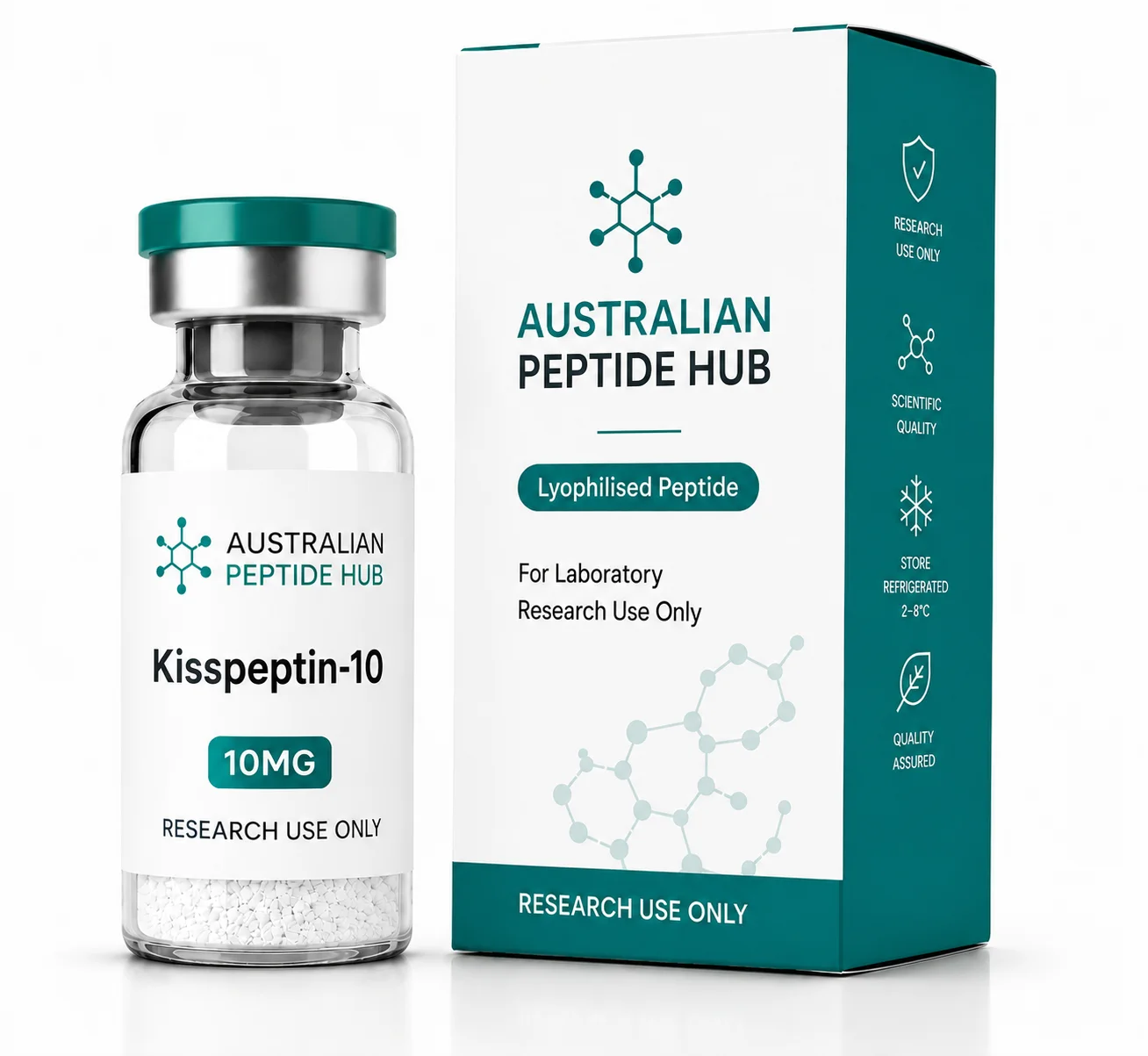
Kisspeptin-10
$75.00
Processing time is 1–2 business days.
Kisspeptin-10 lyophilised research peptide in Australia, supplied for in-vitro laboratory investigation. Synthetic 10-amino-acid C-terminally amidated decapeptide and reference ligand at the KISS1R (GPR54) receptor (sequence YNWNSFGLRF-NH₂). ≥99% purity by HPLC, third-party Certificate of Analysis available. Dispatched within 1-3 business days. Research use only. Not for human consumption, therapeutic use, or diagnostic application.
Research Context
Kisspeptin-10 (KP-10, metastin 45-54) is a 10-amino-acid C-terminally amidated decapeptide derived from the larger 54-residue kisspeptin (metastin) precursor encoded by the KISS1 gene. It corresponds to the minimal C-terminal core sequence required for full agonist activity at the kisspeptin receptor KISS1R (also known as GPR54), and is widely used as a reference ligand in receptor pharmacology. The peptide is generated in vivo by proteolytic processing of the kisspeptin precursor and retains the biological potency of the longer kisspeptin-54 form.
Preclinical studies have examined KP-10 as a probe of KISS1R signalling in reproductive neuroendocrinology, particularly its role in modulating gonadotropin-releasing hormone (GnRH) neuron activity, gonadotropin secretion dynamics, and pubertal axis maturation in animal models. The peptide has also been used to investigate KISS1R expression in placental tissue and as a tool compound in tumour metastasis research given the gene name origin (KISS1, suppressor of metastasis).
Chemistry & Structural Modification
Linear 10-residue peptide with sequence H-Tyr-Asn-Trp-Asn-Ser-Phe-Gly-Leu-Arg-Phe-NH₂ (YNWNSFGLRF-NH₂). C-terminal amidation of the phenylalanine carboxyl is essential for receptor binding affinity.
- Molecular formula: C63H83N17O14
- Molecular weight: 1302.44 g/mol
- CAS number: 374675-21-5; PubChem CID 25240297
Lyophilisation & Stability
Supplied as a lyophilised white-to-off-white powder in a sealed glass vial. Lyophilisation removes residual water that would drive C-terminal amide hydrolysis and tryptophan oxidation, both significant degradation pathways for this sequence. The dry-state form is stable for extended periods provided the vial is kept sealed, cold, and protected from light. Open vials and reconstituted material are markedly less stable.
Storage
Store lyophilised vial at 2 to 8°C, protected from light. (Long-term storage at −20°C is standard practice.)
Reconstituted solution: 2 to 8°C, used within 14 to 30 days. Avoid repeated freeze–thaw cycles.
Quality & Documentation
- Purity: ≥99% by HPLC
- Certificate of Analysis (COA): published on our COA page.
Related products
-
Tesamorelin
$89.00 Select options This product has multiple variants. The options may be chosen on the product page -
GHK-Cu
Price range: $40.00 through $70.00 Select options This product has multiple variants. The options may be chosen on the product page -
SS-31
$69.00 Select options This product has multiple variants. The options may be chosen on the product page