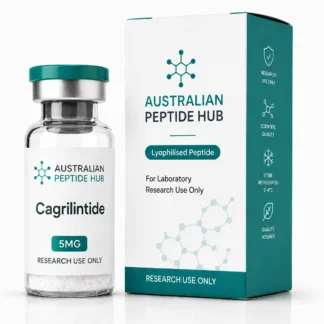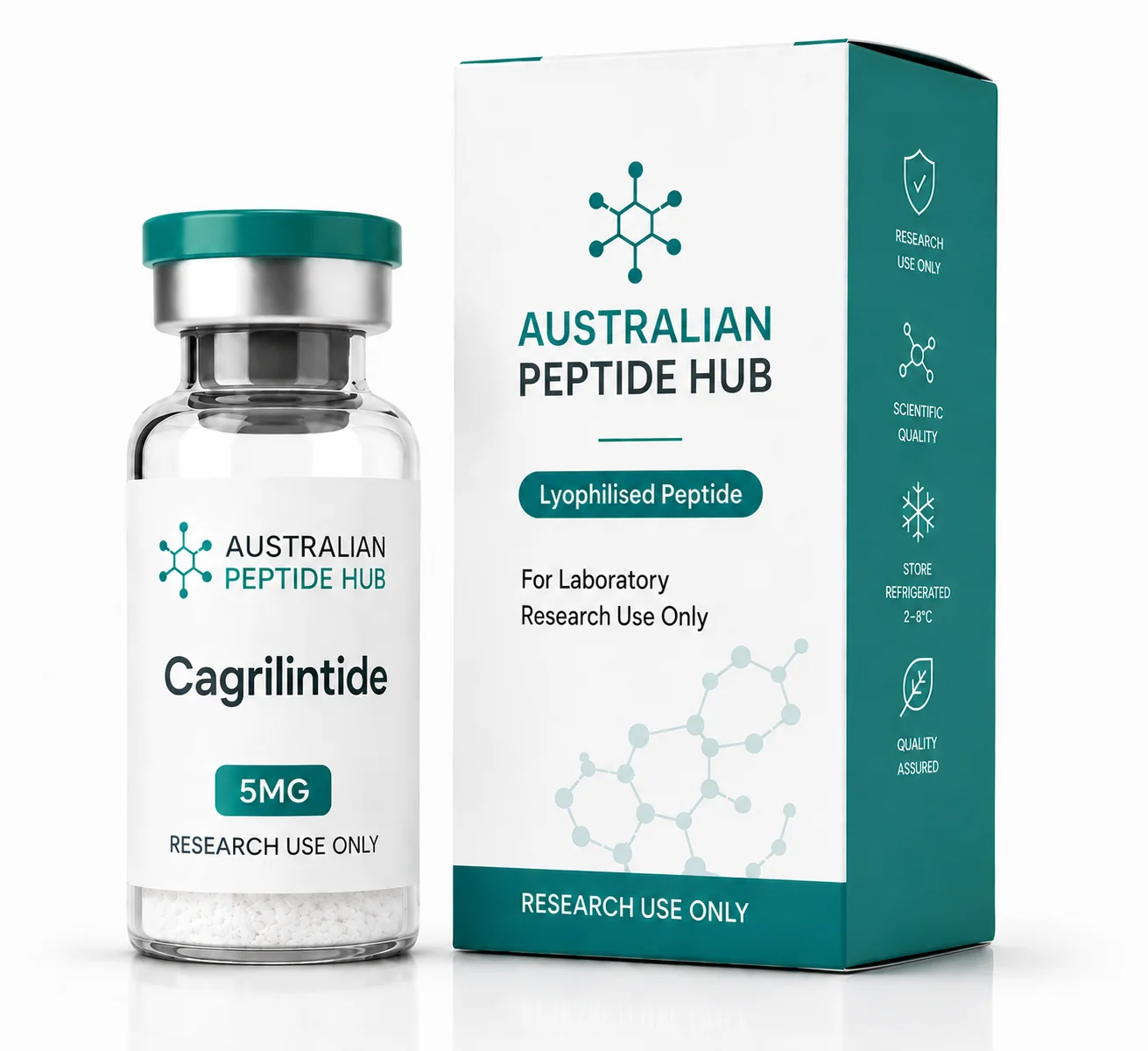
Cagrilintide
$85.00
Processing time is 1–2 business days.
Cagrilintide lyophilised research peptide in Australia, supplied for in-vitro laboratory investigation. Long-acting synthetic acylated amylin analogue (37-residue modified backbone with C20 fatty-diacid acylation, approximately 4409 Da), investigational pan-amylin and calcitonin receptor agonist. ≥99% purity by HPLC, third-party Certificate of Analysis available. Dispatched within 1-3 business days. Research use only. Not for human consumption, therapeutic use, or diagnostic application.
Research Context
Cagrilintide is a long-acting synthetic amylin analogue. It is built on a 37-residue modified human amylin / pramlintide-style backbone with three rationally designed substitutions (N14E and V17R to stabilise the central alpha-helix through a salt bridge, P37Y to enhance calcitonin-receptor potency) and N-terminal acylation with a C20 eicosanedioic fatty diacid attached via a gamma-glutamic acid linker. The fatty-diacid handle drives reversible albumin binding in plasma-stability assays.
Preclinical studies have examined cagrilintide as a non-selective agonist of the amylin receptors (AMY1R, AMY2R, AMY3R) and the calcitonin receptor in cultured cells and rodent tissue. No therapeutic, performance, or human-use claims are made or implied.
Chemistry & Structural Modification
Cagrilintide is a 37-amino-acid lipidated peptide. Key structural features include N14E and V17R substitutions (helix stabilisation), 25P/28P/29P proline substitutions (suppression of beta-sheet propensity and amyloid fibril formation, the primary instability mode of native human amylin), a C-terminal proline-to-tyrosine substitution (P37Y) for calcitonin-receptor activity, and N-terminal C20 fatty-diacid acylation via a gamma-Glu linker. The molecule retains the conserved Cys2-Cys7 intramolecular disulphide bridge inherited from the amylin/pramlintide scaffold.
- Molecular formula: C194H312N54O59S2
- Molecular weight: ~4409 Da
- CAS number: 1415456-99-3; PubChem CID 171397054
Lyophilisation & Stability
Cagrilintide is supplied as a lyophilised white powder, sealed under controlled conditions. Lyophilisation removes residual moisture that would otherwise accelerate amide-bond hydrolysis and disulphide scrambling during long-term storage. The proline substitutions at positions 25, 28, and 29 were specifically engineered to suppress the beta-sheet aggregation pathway that destabilises native human amylin in aqueous solution. Sealed vials kept cold and dry retain ≥99% potency well within the labelled shelf life.
Storage
Store lyophilised vial at 2 to 8°C, protected from light. (Long-term storage at −20°C is standard practice.)
Reconstituted solution: 2 to 8°C, used within 14 to 30 days. Avoid repeated freeze–thaw cycles.
Quality & Documentation
- Purity: ≥99% by HPLC
- Certificate of Analysis (COA): published on our COA page.
Related products
-
SS-31
$69.00 Select options This product has multiple variants. The options may be chosen on the product page -
Melanotan-1
$55.00 Select options This product has multiple variants. The options may be chosen on the product page -
BPC-157
$70.00 Select options This product has multiple variants. The options may be chosen on the product page